You’re standing in front of a mirror holding two silver chains — one delicate and gossamer-thin, one chunkier and more structured — trying to figure out how they’ll work together around your neck without tangling, breaking, or looking like an accident. If you’ve gotten past “just buy a necklace” and are now thinking about which chain, what length, and whether that clasp will hold, you’re in exactly the right place. This guide breaks down sterling silver chain necklaces specifically for layering: the three technical variables that determine whether your stack looks intentional and wears well (gauge, length, and clasp construction), plus the decision framework for matching them to your actual lifestyle and aesthetic. By the end, you’ll have a clear “if X, then Y” path for every buying decision in this category.
Why Gauge Is the Variable Most Buyers Underestimate
Gauge — the thickness of the wire used to construct the chain — is measured in millimeters (mm) and is the single biggest driver of both visual weight and structural durability. The Gem Society’s chain and necklace buying guide identifies gauge as the primary factor separating chains that survive daily wear from those that stretch, kink, or snap within months.
Here’s the practical spectrum for sterling silver layering chains:
0.8–1.0 mm — Ultra-delicate. These read as barely-there, ideal as the “whisper” layer in a three-chain stack. The tradeoff: they’re the most prone to kinking and the most likely to suffer fatigue at the clasp junction under daily friction. Owners of sub-1mm chains in aggregated reviews consistently report that these work beautifully but require more mindful handling — removing before sleep and exercise is nearly universal advice.
1.2–1.5 mm — The sweet spot for most layering applications. Substantial enough to hold a small pendant without distorting, fine enough to disappear beneath a chunkier anchor chain. This is the gauge range The Knot’s jewelry buying guide implicitly targets when recommending “everyday” sterling silver chains.
2.0–3.0 mm — The anchor or statement layer. Figaro, Cuban, or rope chains in this range provide visual mass and structural backbone for a stack. They’re also more forgiving of the daily friction that comes from contact with clothing and skin.
The layering math: A well-composed stack typically uses at least two different gauges — a fine chain (≤1.2 mm) and a medium or heavy chain (≥1.8 mm) — to create visual separation between layers. Three identical gauges at the same length read as clutter rather than intention.
Length Laddering: The Architecture of a Layered Stack
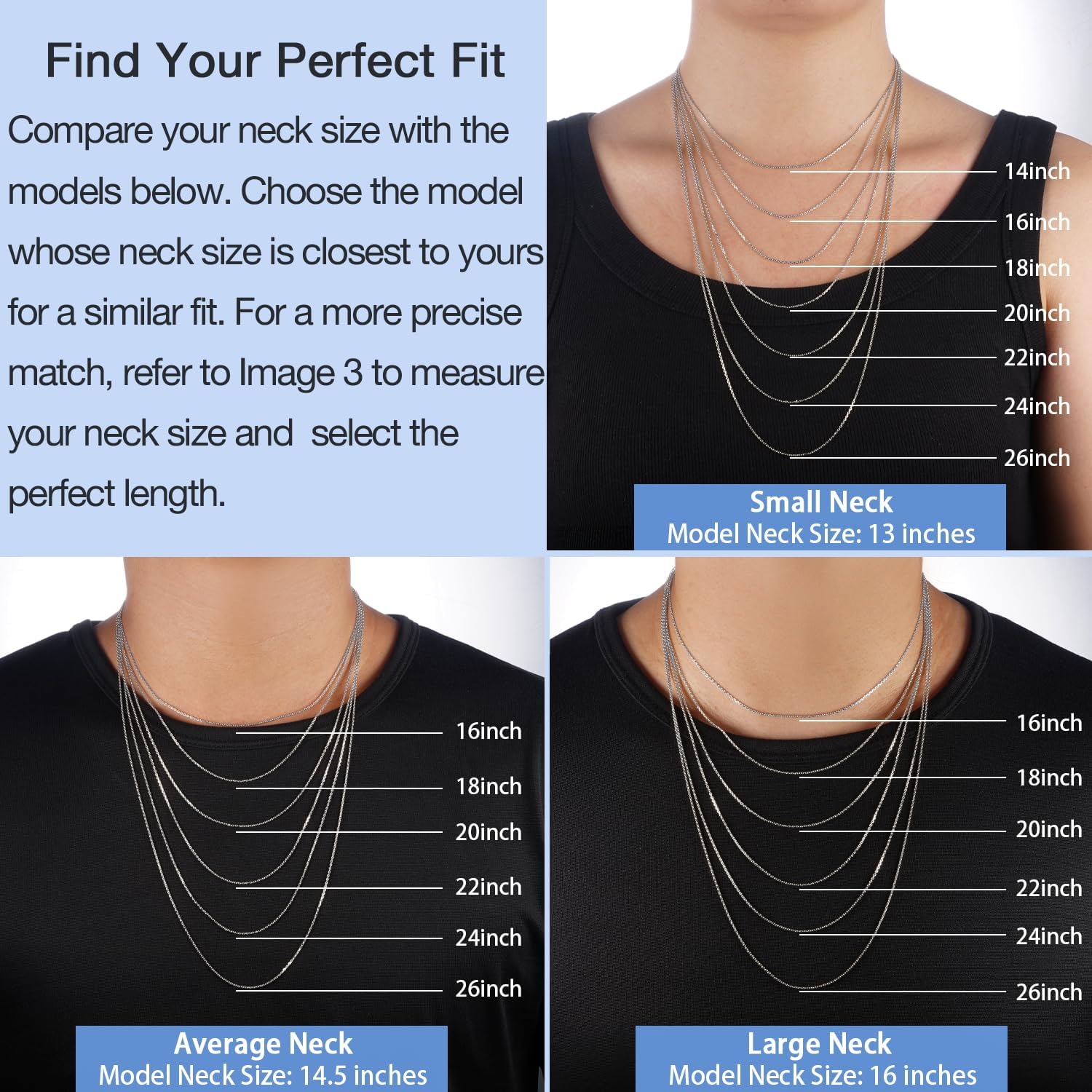
Length is where most intermediate buyers have the framework right but the execution wrong. The principle is simple — stagger lengths so each chain is visible and distinct — but the specific increments matter more than most guides acknowledge.
Standard reference lengths and their neckline placement:
| Length | Typical Placement | Best Role in a Stack |
|---|---|---|
| 14–16 in | Collarbone / choker | Top layer, structural anchor |
| 18 in | Just below collarbone | Mid layer, pendant carrier |
| 20–22 in | Upper chest | Third layer, statement or coin pendant |
| 24–30 in | Mid-chest to sternum | Longest layer, geometric or tassel pendant |
Harper’s Bazaar’s necklace layering trend coverage consistently notes that a minimum 2-inch differential between each chain is the practical floor for visual separation — less than that and chains compete rather than complement. For a three-chain stack, that means you’re looking at 16 / 18 / 20 at the tightest, and 16 / 20 / 24 for maximum definition.
The body-proportion variable: Standard length guides are calibrated for a roughly average neckline and torso length. If you’re petite, subtract 1–2 inches from each benchmark (a standard 18-inch chain may hit at mid-chest rather than below-collarbone). If you’re tall or have a longer torso, the same 18-inch chain reads shorter and may disappear under a collar. Brides’ jewelry buying coverage flags this as one of the most common reasons a layered look that photographs beautifully on a model doesn’t translate to the buyer’s actual neckline.
Adjustable extenders as a decision-making tool: If you’re buying online without the ability to try on, an extender chain (typically 2–3 inches of chain with a loop at each end) lets you test multiple lengths before committing. Many mid-market sterling silver brands now include these — it’s worth treating the absence of an extender as a minor negative when comparing two otherwise equal options.
Clasp Quality: The Part That Fails First
The clasp is where sterling silver layering chains earn or lose their long-term value. GIA’s overview of jewelry metals and construction notes that the junction between chain and clasp is the highest-stress point in any necklace — it bears the full weight of the chain and pendant while absorbing the repeated mechanical stress of opening and closing. In layered applications, where chains may be handled daily as individual pieces rather than worn as a fixed set, clasp quality is even more consequential.
The four clasp types you’ll encounter in sterling silver chains:
Spring-ring clasp — The small circular clasp with a spring-loaded lever. Ubiquitous at entry price points. Functional, but the spring mechanism is the first component to fail; owners in long-run reviews consistently report spring fatigue within 12–18 months of daily use on lighter chains. Acceptable for occasional-wear or lower-gauge chains where you’re not fighting significant pendant weight.
Lobster-claw clasp — The asymmetric, tapered clasp that opens via a small lever on one side. The standard choice for mid-market sterling silver and the de facto recommendation from jewelers for daily wear. More robust spring mechanism than the spring-ring, easier to operate single-handed, and available in sizes calibrated to chain gauge. The Gem Society’s buying guide identifies the lobster-claw as the baseline for chains carrying pendants over 3 grams.
Toggle clasp — A T-bar that passes through a circular ring. Elegant and easy to operate, but it relies entirely on gravity and the T-bar’s fit within the ring to stay closed. Not recommended for single-chain wear around an active neckline; works best as a design-forward choice on a longer chain (22+ inches) where the pendant weight keeps the toggle seated. Reviewers flag toggle clasps as a weak point in thinner ring tolerances — look for a ring diameter at least 1.5× the T-bar length.
Box clasp with safety tab — A rectangular box clasp with a folded-metal safety tab that clicks over the closure. Common in pearls and multi-strand necklaces; occasionally seen in high-end sterling silver chains. The most secure option under sustained weight, but the most mechanically complex and the most expensive to repair if the safety tab fatigues. Worth seeking out for heavy anchor chains (3.0 mm+) or chains carrying significant pendant weight.
The gauge-to-clasp matching rule: A chain’s clasp should be proportional to its gauge and intended load. Using a small spring-ring clasp on a 2.5mm Cuban link looks wrong and fails faster. A lobster-claw scaled to the chain width is the minimum for any pendant-carrying chain in a daily-wear stack.
Sterling Silver Alloy and Finish: What Actually Affects Tarnish Rate
Sterling silver is 92.5% pure silver alloyed with 7.5% other metals — almost always copper, which provides the hardness silver alone lacks. GIA notes that this copper content is also the primary driver of tarnish: copper oxidizes when exposed to air, moisture, and sulfur compounds (present in skin oils, some lotions, and ambient air), producing the dark patina associated with untreated silver.
Finish options and their practical tradeoffs in layering:
Rhodium plating — A thin layer of rhodium (a platinum-group metal) electroplated over the sterling silver surface. Dramatically slows tarnish and adds a bright white luster. The tradeoff: rhodium plating is 0.5–2 microns thick and wears away at friction points — clasps, pendant bails, and any area in consistent contact with skin or clothing. A rhodium-plated chain being worn in a daily stack will show wear at these points within 1–3 years, depending on activity level. Re-plating is widely available from local jewelers at a modest cost.
Anti-tarnish treatments — Some manufacturers apply proprietary surface treatments that slow oxidation without the opacity of rhodium. Results vary significantly by brand; owner reviews are the most reliable signal here.
Untreated sterling — Develops a natural patina that many buyers prefer, especially for vintage or oxidized-style aesthetics. Polishing cloths (impregnated with mild abrasive compounds) restore the bright finish in minutes.
The practical verdict for layering stacks: If you’re building a stack you’ll wear most days, rhodium-plated chains require the least maintenance over a 1–2 year horizon. If you’re building a more curated, occasional-wear stack, untreated sterling with a polishing routine is more durable at the friction points and easier to repair when the finish wears.
The Decision Framework: If X, Then Y
The goal of this section is to collapse the variables above into actionable buying rules.
If you want a three-chain everyday stack that travels well and requires minimal care: Choose rhodium-plated sterling silver in gauges of approximately 0.9 mm / 1.5 mm / 2.5 mm, lengths at 16 / 18 / 22 inches, all with lobster-claw clasps. This combination gives you visual differentiation, structural durability, and clasp reliability without over-engineering.
If you’re adding a single new chain to an existing stack: Identify the closest gauge to your existing chains and go one step lighter or heavier — not the same. If your current chains are all around 1.2–1.5 mm, your gap piece is either ≤0.9 mm or ≥2.0 mm. Length should land at least 2 inches from your current shortest or longest chain.
If you’re buying a chain to carry a pendant heavier than approximately 5 grams: The minimum is a 1.5 mm gauge chain with a lobster-claw clasp. Below 1.5 mm, the fatigue risk at the bail and clasp junction increases significantly with pendant weight. If the pendant exceeds 10 grams, move to 2.0 mm+ and consider a box clasp with safety tab.
If tarnish resistance is a non-negotiable (active lifestyle, frequent sweat exposure): Either invest in rhodium plating and budget for re-plating every 18–24 months, or look at sterling silver with a verified anti-tarnish treatment from the manufacturer. Per Harper’s Bazaar’s layering coverage, vermeil (gold-plated sterling) is an alternative finish that shifts the color palette while improving tarnish performance — worth considering if you’re open to warm tones in part of the stack.
If budget is the binding constraint: A 1.2–1.5 mm lobster-claw cable or box chain at 18 inches in untreated sterling is the highest-utility single purchase under $50. It layers with almost anything, carries light pendants reliably, and polishes back to new with a $5 cloth. Start there before investing in the full stack architecture.
The decisions above aren’t complicated once gauge, length, and clasp are understood as distinct variables with distinct failure modes. The buyers who struggle are those treating “silver chain” as a single undifferentiated choice — the ones who do the work of matching gauge to pendant weight, lengths to neckline, and clasps to wear frequency end up with stacks that hold together for years rather than months.