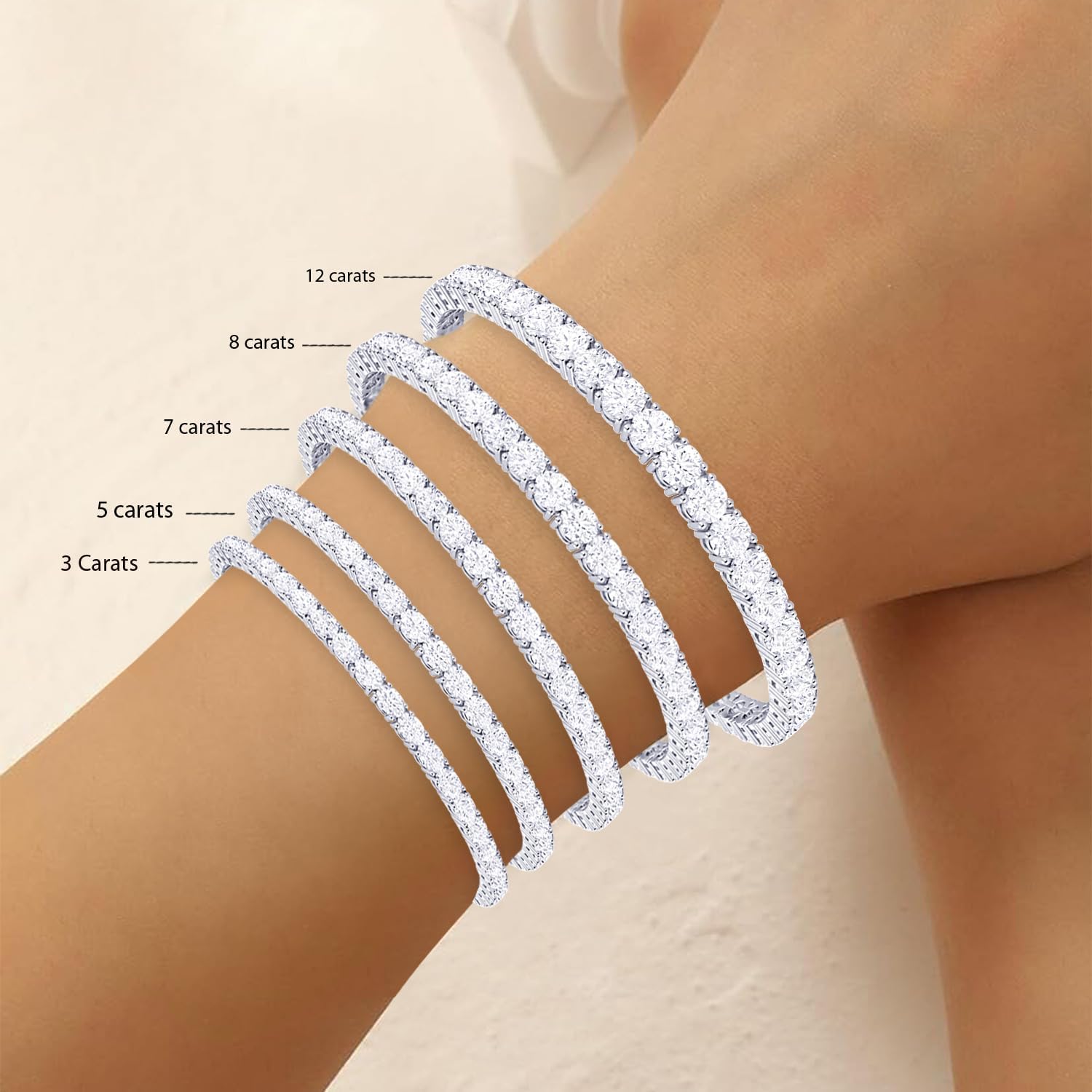
Picture this: you’ve narrowed your tennis bracelet search to lab-grown diamonds, your budget is settled, and you’re staring at two bracelets that look nearly identical in the product photos — same total carat weight, similar price, both described as “VS clarity.” But one has a four-prong setting and the other is a bezel (a thin metal rim that wraps completely around each stone). The retailer’s copy doesn’t explain which is better for daily wear, or whether the clarity grade even matters once the stones are set. You’re not overthinking it — these are exactly the details that separate a bracelet you’ll wear every day from one you’ll treat like a museum piece.
A tennis bracelet is a flexible, in-line bracelet in which a continuous row of identically sized diamonds (or other stones) runs around the wrist. The name dates to a 1987 U.S. Open moment when player Chris Evert’s diamond bracelet snapped off mid-match — the term stuck. The lab-grown qualifier means the diamonds were grown in a controlled environment rather than mined; they are chemically and optically identical to earth-mined stones (per the Gemological Institute of America’s overview What Is a Lab-Grown Diamond?), and they trade at a significant discount. As of mid-2026, lab-grown diamond prices have continued their multi-year softening, with PriceScope’s market-data tracking showing round brilliant lab-grown stones trading at roughly 80–90% below comparable natural equivalents on a per-carat basis — which means your dollar buys dramatically more total carat weight in a tennis bracelet than it would have five years ago.
What that price advantage doesn’t do automatically is tell you which setting construction is worth paying a premium for, or where to stop spending on clarity. That’s what this guide works through.
The Setting Decision Is a Durability and Light Decision at the Same Time
The two dominant setting architectures in tennis bracelets are prong and bezel, and they involve a real tradeoff — not just aesthetics.
Prong settings use small metal claws (typically two, four, or six per stone) to grip each diamond at its girdle (the widest edge of the stone). The diamond sits elevated, more light enters from the sides, and brilliance is maximized. The tradeoff: prongs can catch on fabric, hair, and fine-knit sweaters. Over years of daily wear, prong tips work-harden and can lift slightly — a condition that requires routine inspection and occasional re-tipping by a bench jeweler.
Bezel settings encircle each stone in a continuous metal rim. The diamond sits lower, the profile is sleeker, and there are no protruding prongs to snag. The metal rim does block some lateral light entry, which slightly reduces the “fire” (colored light flashes) compared to a prong-set stone of identical cut grade. The practical benefit is meaningful: bezels provide better stone retention, which is why they’re commonly recommended by the bench-jeweler community for active wearers. Brides.com’s tennis bracelet guide notes bezel-set bracelets as a top recommendation for people who wear jewelry through workouts or manual work.
Four-prong vs. six-prong in prong settings is a sub-decision worth naming explicitly. Six prongs hold each stone more securely and distribute stress more evenly, but they cover slightly more of the diamond’s crown (the top faceted surface), which can make a stone look marginally smaller. Four prongs expose more of the stone, maximize brilliance, and are the dominant choice in mid-market tennis bracelets. For total carat weights under 5 carats, where the individual stones are smaller and the prong-to-stone ratio is tighter, four-prong is the standard; six-prong becomes more common in heirloom-grade pieces with larger individual stones (0.15 ct and above per stone).
If your primary use is daily, active wear — meaning it’s on your wrist through the gym, the kitchen, and the office — the bezel setting’s durability advantage outweighs its optical cost. If the bracelet is more occasion-to-daily but you’re prioritizing maximum sparkle, a well-made four-prong design in 14k or 18k white gold is the standard choice, and you inspect it annually.
Clarity Grades: Where the Spending Stops Mattering in a Tennis Bracelet
This is where buyers consistently over-spend, and it’s worth being direct about the math.
In a traditional GIA clarity grade (per the GIA Diamond Clarity Grading chart), the scale runs from Flawless (FL) down through VVS1/VVS2, VS1/VS2, SI1/SI2, and into I1/I2/I3. The distinctions between grades reflect the size, nature, and location of internal characteristics called inclusions (internal flaws) and blemishes (surface irregularities). A VS2 stone has inclusions that are minor and difficult to see even under 10× magnification. An SI1 stone has inclusions that are noticeable under 10× magnification but typically invisible to the naked eye.
The critical variable in a tennis bracelet is stone size. Most tennis bracelets in the 3–7 total carat range use individual stones between 0.08 and 0.20 carats each. At that size, the practical visibility threshold drops significantly. The International Gem Society’s diamond clarity reference notes that inclusions affecting eye-cleanliness in larger solitaires may be entirely invisible in melee-sized stones (stones under 0.20 ct) simply because the stone is too small for the human eye to resolve the detail. That dynamic is amplified when dozens of stones are set in motion on a bracelet.
By the Numbers
| Clarity Grade | What it Means | Eye-Clean in Tennis Bracelet (0.10–0.18 ct stones)? | Premium Worth Paying? |
|---|---|---|---|
| VVS1 / VVS2 | Very very slight inclusions | Yes — unambiguously | Only if resale/documentation matters to you |
| VS1 / VS2 | Very slight inclusions | Yes — reliably | Sweet spot for most buyers |
| SI1 | Slight inclusions, 10× visible | Almost always | Strong value; inspect stone images first |
| SI2 | Slight inclusions, sometimes eye-visible | Usually, in melee | Budget-conscious buy; vet per-stone imaging |
The practical conclusion: VS2 is the clarity ceiling that makes financial sense for the vast majority of lab-grown diamond tennis bracelets. The difference between VS2 and VVS1 in a 0.12-ct stone set in a bracelet is not visible to any human eye without magnification. PriceScope’s community data consistently shows that practitioners purchasing tennis bracelets for wear (rather than investment resale documentation) cap out at VS2, and many experienced buyers are comfortable at SI1 after reviewing per-stone imaging.
The one exception: if you’re purchasing a bracelet that will be used as a documented asset — say, an heirloom piece you plan to insure at appraised replacement value and eventually pass down — then VS1 or better gives you a cleaner grading story. But that’s a documentation decision, not a visual quality decision.
Metal Choice and How It Interacts With Setting Style
Setting style doesn’t exist in isolation from metal choice, and in lab-grown diamond tennis bracelets specifically, the metal decision shapes both appearance and long-term maintenance.
14k white gold is the volume choice in the mid-market ($500–$2,500 range) for good reasons: it’s harder than 18k, which means prong tips in a prong-set bracelet wear more slowly. The rhodium plating that gives white gold its bright white finish will wear through over 1–3 years of daily wear and require re-plating (a standard bench service, typically $50–$100). This matters more in prong settings than bezels because the prong tips are high-contact, high-stress points.
18k white gold is softer but carries more gold content (75% vs. 58.3%), which appeals to buyers with documented metal sensitivities to nickel alloy (commonly used in 14k white gold as a hardening agent). For a bezel-set bracelet, 18k is a reasonable choice because the continuous rim distributes stress more evenly than prong tips. For a prong-set design in 18k, the annual inspection cadence should be treated as mandatory rather than optional.
Platinum in a tennis bracelet setting is relatively uncommon below the $5,000 range for lab-grown pieces, but it’s the most durable option for prong settings over decades of wear — platinum prongs develop a patina rather than losing metal, which actually creates a tight grip over time rather than loosening. The Knot’s tennis bracelet buying guide notes platinum as the premium choice for heirloom intent, and that editorial position holds up in practice for buyers in the $4,000+ segment.
Yellow gold and rose gold in prong settings show the metal color within the prong itself, which creates a visible warm tone against the white diamond. In bezel settings, the warm metal rim is more prominent and can be a deliberate design choice — the metal becomes part of the aesthetic rather than a structural afterthought.
The Decision Framework: Matching the Build to the Buyer
If you’re currently evaluating a specific bracelet or comparing two options under consideration, here’s the simplified decision tree:
If the bracelet is for daily active wear → bezel setting, 14k or 18k white gold, VS2 clarity. You’re prioritizing durability and stone retention. The optical trade-off in a bezel is real but minor, and you’ll never lose a stone to a lifted prong.
If the bracelet is primarily occasion wear with some daily use → four-prong setting, 14k white gold, VS2 (or VS1 if budget allows and documentation matters). Annual inspection is realistic for an occasional-wear piece. The added brilliance is worth it in this use pattern.
If the bracelet is an heirloom or documented high-value piece → six-prong or bezel in platinum, VS1 or better, with GIA or IGI grading documentation per stone or per bracelet. The setting and clarity grades need to hold up in an insurance appraisal and a conversation about provenance decades from now.
On clarity in all three cases: do not pay VVS prices for stones under 0.20 ct in a moving, set piece. That clarity premium is invisible in wear. Redirect that budget toward total carat weight, metal quality, or setting craftsmanship — all of which you and everyone around you will actually perceive.
The lab-grown diamond market’s continued price compression as of 2026 means total carat weight is genuinely affordable in a way it wasn’t even three years ago. The risk isn’t spending too little on the stones — it’s spending the wrong portions on grades that don’t translate to visible beauty in a bracelet specifically. Get the setting right, get the metal matched to your lifestyle, and let the clarity grade be determined by the eye-clean threshold, not the grading certificate’s prestige.