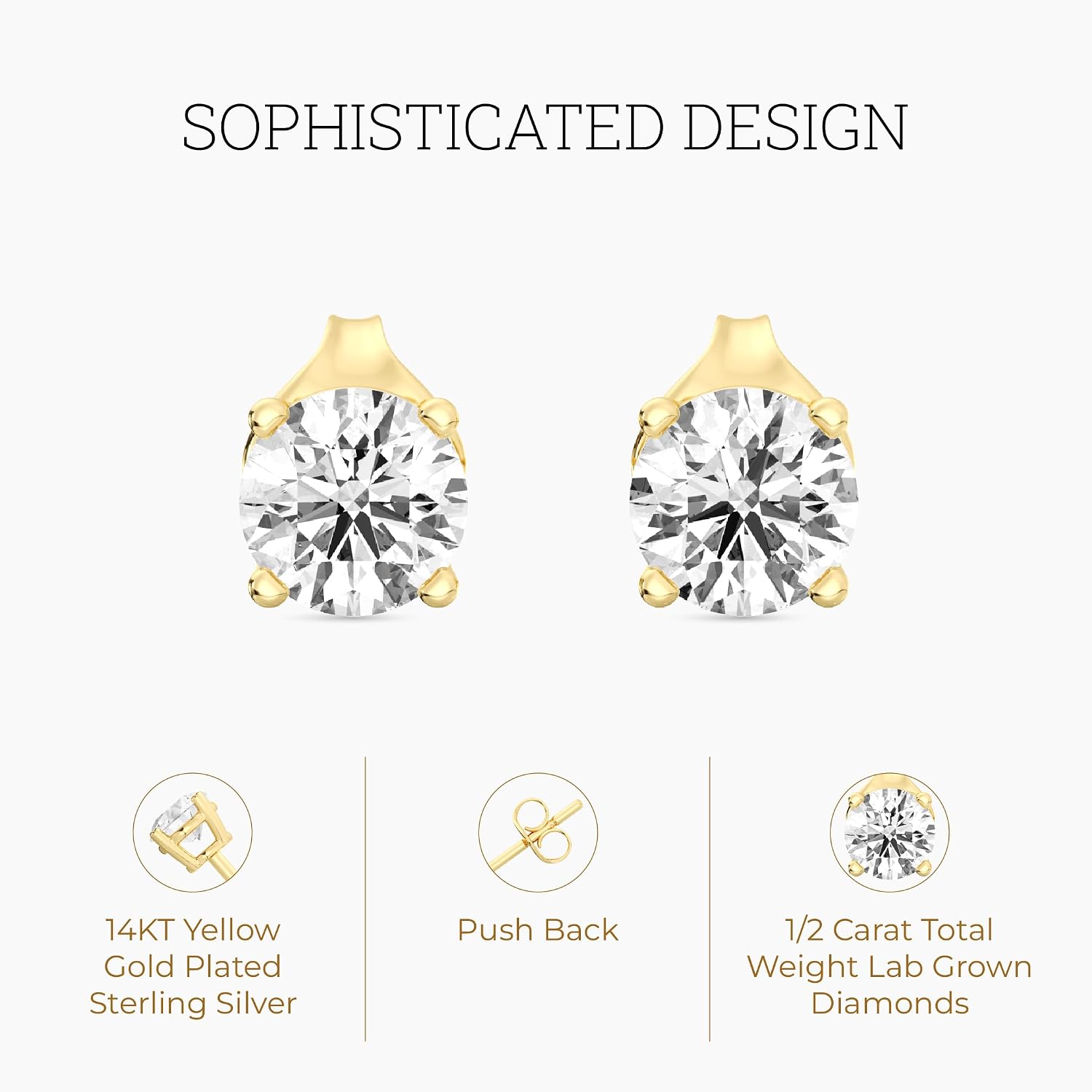
You’ve already decided lab-grown diamond studs make sense. Smart call. Lab-grown diamonds (stones chemically and physically identical to mined diamonds, created in a controlled environment rather than extracted from the earth) have collapsed in price over the past three years and now land at roughly 70–85% below natural-diamond equivalents of the same grade, per pricing data tracked by Pricescope’s lab-grown diamond forum threads through early 2026. The question you’re sitting with isn’t whether to buy lab-grown—it’s how to avoid paying a clarity premium that adds nothing to how the earrings actually look, or choosing a metal that corrodes in a year, or trusting an IGI grade without knowing what that grade actually covers. This guide answers all three, with the math visible so you can pressure-test the decision yourself.
Why IGI Is the Default Grade for Lab-Grown Studs—and Where to Read It Carefully
The GIA (Gemological Institute of America) is the global gold standard for diamond certification. For natural diamonds, most serious buyers won’t consider an un-GIA-graded stone above a few hundred dollars. For lab-grown diamonds, the picture is messier. GIA grades lab-grown stones, but the dominant grading lab you’ll encounter on studs sold through direct-to-consumer retailers—James Allen, Brilliant Earth, Clean Origin, and most Etsy-adjacent wholesale suppliers—is the IGI (International Gemological Institute).
IGI isn’t a lesser lab in a disqualifying sense. Per the GIA’s own published guidance on lab-grown diamond grading, both labs apply the 4C framework (Cut, Color, Clarity, Carat weight) to lab-grown stones. The practical difference worth knowing: IGI grades lab-grown diamonds on a report that is separate from its natural-diamond reports, and IGI has historically graded lab-grown color and clarity one to two grades more generously than GIA grades comparable stones, according to comparative analysis published in Pricescope forum discussions and corroborated by independent gemologists quoted in Brides’ 2025 lab-grown buying guide.
What this means when you’re comparing two pairs of studs:
- An IGI VS1 / G stone may grade closer to VS2 / H on GIA’s scale.
- That doesn’t make it a bad stone. It means the IGI certificate alone doesn’t let you do a clean apples-to-apples comparison against a GIA-graded natural or against another retailer’s GIA-graded lab stone.
- The practical fix: shop within the same grading lab when comparing, and lean on the retailer’s high-resolution imagery or ASET/Idealscope data for cut quality, which the grade alone won’t tell you.
For studs specifically, the cut-quality caveat matters less than it does for an engagement ring solitaire (because earrings are viewed at distance and in motion), but it’s still worth confirming the stones carry at least a “Very Good” or “Excellent” cut grade on the report.
The Clarity Decision: Where the Grade Matters and Where It’s Wasted Money
The Gem Society’s diamond clarity scale runs from Flawless (FL) at the top, through VVS1/VVS2, VS1/VS2, SI1/SI2, and into the included (I) grades at the bottom. Inclusions are internal characteristics—tiny crystals, feathers, or clouds—that affect both beauty and structural integrity depending on their type, size, and location.
For stud earrings, the practical clarity ceiling is lower than most people realize, and overspending here is the single most common mistake the intermediate buyer makes.
By the numbers — clarity vs. eye-cleanliness in 1 ctw studs (two 0.50 ct rounds), approximate 2026 pricing:
| Clarity | Eye-clean at arm’s length? | Approx. price range (IGI, lab-grown) |
|---|---|---|
| VVS1–VVS2 | Yes | $1,100–$1,600 per pair |
| VS1–VS2 | Yes | $700–$1,100 per pair |
| SI1 | Usually yes | $480–$700 per pair |
| SI2 | Often yes | $340–$480 per pair |
| I1 | Sometimes | Under $300 per pair |
Prices sourced from aggregated retailer listings reviewed via Pricescope tracking, May 2026. Ranges assume G–H color, round brilliant cut, standard 14k white-gold prong settings.
The Knot’s diamond stud buying guide explicitly flags that SI1 is typically the “sweet spot” for earrings because inclusions are not visible to the naked eye at conversational distance, and the savings over VS2 are substantial. This analysis is consistent with gem-education resources at GemSociety.org, which note that eye-cleanliness—not the certificate grade—is the relevant metric for jewelry worn at normal viewing distances.
Decision rule: If you’re buying studs for everyday wear and your budget is under $1,500 for the pair, buy SI1 and put the savings toward carat weight or metal quality. The only scenario where VVS makes sense for studs is if you’re buying for a collector who will examine them under magnification, or if the studs are a documented investment piece where resale grade matters.
One caveat worth naming explicitly: SI2 lab-grown stones vary more widely than SI2 naturals because certain lab-grown growth types (particularly HPHT-grown stones) can produce specific inclusion patterns—metallic flux inclusions—that are atypical in mined diamonds. Before accepting an SI2 grade on a lab-grown stone, confirm the retailer’s imagery shows the actual stone, not a stock photo, and that the IGI report specifies the inclusion type.
Metal Choice: The Decision That Actually Affects Five-Year Ownership
This is where buyers who’ve done the gemstone homework sometimes stumble. You’ve correctly optimized the stone—now don’t put it in a metal that creates problems.
14k white gold vs. 18k white gold vs. platinum: the honest breakdown
14k white gold is the industry standard for mass-market and direct-to-consumer lab-grown stud settings. It contains 58.5% pure gold alloyed with metals that contribute hardness and white color. The key fact that most retailers understate: white gold is not naturally white. It achieves its color through a rhodium plating (a bright, reflective metal from the platinum family) applied over the yellowish gold alloy. That plating wears off—typically within 12–24 months of regular wear, per care guidance published by multiple fine-jewelry retailers and referenced in Brides’ lab-grown jewelry guide. Re-rhodium-plating a pair of studs typically costs $25–$60 at a local jeweler and is a routine maintenance step, not a defect. Know going in that it’s part of ownership.
18k white gold contains 75% pure gold. It’s softer than 14k, marginally more yellow underneath the rhodium plating, and more expensive. For studs—a lower-wear application than rings—18k gold’s softness disadvantage is negligible. The extra cost buys you a higher purity stamp and a slightly warmer look if the rhodium wears unevenly, but it’s not meaningfully better for earrings than 14k.
Platinum is the correct answer if you want to eliminate replating entirely. Platinum is naturally white, doesn’t require rhodium plating to achieve its color, and develops a patina (a subtle matte texture) rather than wearing through. Its disadvantage is price: a platinum stud setting runs roughly 40–60% more than a comparable 14k white-gold setting for the same stone, per pricing comparisons reviewed across Brilliant Earth and Whiteflash product listings in early 2026. For a $2,000+ pair of studs where the stones are the investment, the incremental cost of platinum settings—often $150–$400 more—is worth considering seriously. For a $600 pair of SI1 studs, it likely changes the value equation enough that 14k white gold with planned replating is the pragmatic call.
Yellow gold and rose gold deserve mention: both are genuinely beautiful with lab-grown diamonds and have no structural disadvantages compared to white gold for earrings. The optical caveat is that yellow or rose gold prongs slightly warm the apparent color of the diamond. On a D–F color stone, this is a meaningful consideration—you’re paying a color premium that gets partially neutralized by the setting. On a G–I color stone (perfectly fine for earrings), the metal’s warmth is imperceptible and a yellow-gold setting can look intentional and sophisticated. If color grade matters to you, pair your premium color with a white metal. If color grade is secondary, any metal works.
Reading the Full IGI Report: Four Fields Most Buyers Skip
When the certificate PDF lands in your inbox (reputable retailers send this pre-delivery), most buyers check color, clarity, and carat, then stop. Here’s what the intermediate buyer also looks at:
1. Fluorescence. IGI reports list fluorescence as None, Faint, Medium, Strong, or Very Strong. In lab-grown diamonds, strong blue fluorescence can sometimes create a milky or hazy appearance in daylight. For studs, this matters slightly less than in engagement rings, but Medium–None is the safe range. If a retailer is offering a strong-fluorescence stone at a significant discount, view high-res imagery in natural light before committing.
2. Proportions table. For round brilliants, the IGI report includes a proportions section. For studs, you’re not optimizing for super-ideal cut, but avoid table percentages above 65% or depth percentages above 63%—both can produce a duller, glassy look even with a “Very Good” cut grade.
3. Growth method. IGI reports on lab-grown diamonds indicate whether the stone was grown via CVD (Chemical Vapor Deposition) or HPHT (High Pressure High Temperature). Both methods produce real diamonds. HPHT stones occasionally show graining or the metallic inclusions noted earlier; CVD stones sometimes show a slight grayish or brownish tint in lower color grades. Neither is categorically superior, but knowing the growth method helps you interpret other aspects of the report.
4. Report number verification. The IGI report number is searchable directly on IGI’s website. Before finalizing any purchase, verify the number matches the stone’s stated grades. This takes 90 seconds and is the simplest fraud check available to you.
The Clear Decision Framework
If you’re holding two options right now, here’s the if/then:
- If budget is under $800 for the pair: SI1 clarity, G–H color, 14k white gold, IGI grade. Buy the best carat weight you can at those grades—size reads more at this budget than tiny clarity upgrades.
- If budget is $800–$2,000: VS2 or SI1, F–G color, 14k white gold or platinum depending on how much you value maintenance-free ownership. This is where a platinum setting upgrade starts earning its cost.
- If budget is $2,000+: VS1–VS2, E–F color, platinum settings, IGI or GIA grade. At this price, the resale story matters—GIA-graded lab-grown diamonds command stronger secondary-market confidence than IGI-graded equivalents, per discussions on Pricescope’s lab-grown tracking threads. Worth the premium.
Lab-grown diamond studs in 2026 are genuinely excellent value relative to their mined counterparts. The overpayment risk isn’t the category—it’s choosing a clarity tier designed for loupe inspection rather than ear-distance wear, or defaulting to a metal that requires maintenance you didn’t budget for. Get those two decisions right and the IGI grade handles itself.