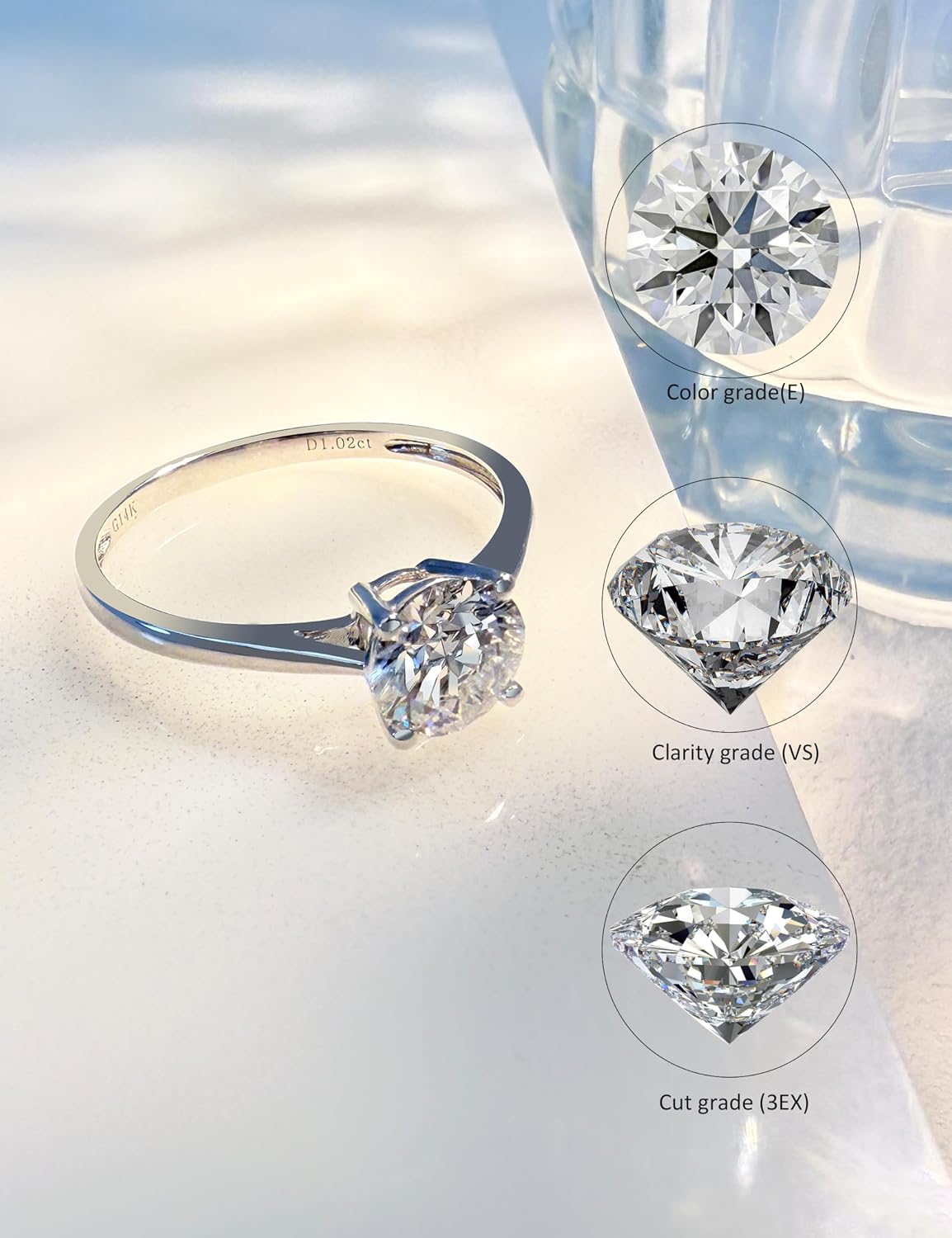
You’ve found the ring. It’s a 2-carat round brilliant lab-grown diamond — created in a controlled facility rather than mined from the earth — and the listing says it comes with an IGI certificate. IGI stands for the International Gemological Institute, one of the most widely used grading labs for lab-grown diamonds. The certificate is supposed to be your assurance that the stone is what the seller says it is: a specific weight, color, and clarity, graded by an independent expert. That’s the promise. The reality is a bit more layered. A certificate is a data snapshot, not a guarantee of beauty — and depending on which version of the IGI report you’re reading, it may leave out information that would genuinely change your decision. This guide walks through exactly what the certificate captures, what it quietly skips, and how to use that knowledge when you’re comparing stones or negotiating a purchase right now.
| EDITOR'S PICK[3 Carat IGI Certified Lab Grown…](https://www.amazon.com/dp/B0CQ5JFS34?tag=greenflower20-20) | Mid-tier[Houston Diamond District 1 to 5…](https://www.amazon.com/dp/B0DNC54PDK?tag=greenflower20-20) | Budget pick[Houston Diamond District 1-6 Ca…](https://www.amazon.com/dp/B09X5Q8J9J?tag=greenflower20-20) | |
|---|---|---|---|
| Cut Shape | Oval | Oval | Round |
| Carat Weight | 3 | 1 | 0.5 |
| Color Grade | E | D-E | E-F |
| Clarity Grade | VS1 | VS1-VS2 | VS1-VS2 |
| Metal Type | 14K Yellow Gold | White Gold | White Gold |
| Price | $1,869.00 | $1,018.98 | $559.59 |
| See on Amazon → | See on Amazon → | See on Amazon → |
What an IGI Report Actually Contains — Field by Field
The International Gemological Institute issues a standardized grading report for lab-grown diamonds that covers the same core attributes as a natural diamond report. If you have one in front of you, here’s what each section means and how much weight to give it.
Report Number and QR Verification. Every IGI report carries a unique number that ties back to a record in IGI’s online database. You can verify this at IGI’s website before purchase — this step is non-negotiable. Confirm the number on the physical or PDF certificate matches the stone’s laser inscription (a microscopic serial number etched on the diamond’s girdle, the thin edge running around its circumference).
Carat Weight. Carat is a unit of mass: one carat equals 0.2 grams. IGI reports this precisely. This field is reliable and consistent across labs.
Color Grade. Diamond color is graded on a D-to-Z scale, where D is colorless and Z carries a noticeable yellow or brown tint. Lab-grown diamonds are predominantly produced in the D–H range. Here is where the first meaningful caveat appears: per analysis published by PriceScope’s community of experienced buyers and gemologists, IGI’s color grades for lab-grown diamonds have historically run approximately one grade more favorable than GIA’s grades on comparable stones. That gap is not universal and IGI has tightened its standards in recent years, but it’s worth pricing in. A stone graded G by IGI might grade H under GIA’s stricter eye.
Clarity Grade. Clarity describes the presence, size, and visibility of internal characteristics (inclusions) and surface features (blemishes). The scale runs from Flawless (FL) to Included (I3). IGI’s clarity grades for lab-grown diamonds are generally considered consistent, though the same slight favorability bias that affects color can appear here. The practical implication: when comparing an IGI VS1 to a GIA VS1 in price, don’t assume they’re identical in appearance.
Cut Grade. For round brilliants, IGI assigns an overall cut grade (Excellent, Very Good, Good, etc.) alongside sub-grades for Polish and Symmetry. This is critically useful data — cut drives more of a diamond’s visual impact than any other factor. A well-cut diamond returns light efficiently; a poorly cut one looks dark or glassy even at high color and clarity. IGI’s cut grading methodology for rounds is broadly respected. For fancy shapes (ovals, cushions, pears), IGI provides polish and symmetry grades but does not issue a standardized overall cut grade — because no industry consensus exists for fancy-shape cut standards. If you’re buying a fancy shape, the cut grade field will simply say “Not Applicable,” and you’ll need to rely on light-performance images or vendor guidance instead.
Growth Method. This field is unique to lab-grown reports and matters more than most buyers realize. IGI specifies whether the diamond was grown via HPHT (High Pressure High Temperature) or CVD (Chemical Vapor Deposition). Both are legitimate processes that produce genuine diamonds, but CVD stones occasionally develop a greyish or “milky” transparency issue that isn’t always captured by the color or clarity grade. Knowing the growth method lets you ask the right follow-up questions and look for the right red flags.
The By-the-Numbers Reality of IGI vs. GIA Grading
If you’re deciding between stones certified by different labs — or weighing an IGI-graded lab diamond against a GIA-graded one — these reference points (drawn from GIA’s published grading methodology documentation and PriceScope’s multi-year community comparisons) frame the tradeoffs quickly:
| Factor | IGI Lab-Grown Report | GIA Lab-Grown Report |
|---|---|---|
| Color grade tendency | ~1 grade favorable vs. GIA (historically) | Industry benchmark strictness |
| Cut grade (round brilliant) | Yes — Excellent through Poor | Yes — Excellent through Poor |
| Cut grade (fancy shapes) | Polish + Symmetry only | Polish + Symmetry only |
| Growth method disclosed | Yes | Yes |
| Report cost (passed to consumer) | Lower | Higher |
| Market adoption for lab-grown | Dominant (est. 70–80% of certified lab diamonds) | Growing rapidly since 2020 |
The Gem Society’s consumer guide to diamond grading reports notes that no lab’s grade should be treated as an absolute truth — all grading involves human judgment applied to a standardized scale, and even the same lab can produce slightly different grades on the same stone on different days.
What the Certificate Does NOT Tell You
This is the section that separates buyers who use a certificate as a checkbox from buyers who use it as a starting point.
It doesn’t tell you how the diamond looks. A certificate describes a diamond’s measurable properties; it cannot tell you whether light dances through the stone the way you want it to. Two diamonds with identical IGI grades can look dramatically different in person. This is why retailers like James Allen and Whiteflash provide 360-degree video of individual stones — that footage reveals light return, contrast patterning, and brilliance in a way no grade can. Per The Knot’s buyer guidance on lab-grown engagement rings, shoppers consistently report that video and imaging tools proved more useful to their final decision than the certificate alone.
It doesn’t capture fluorescence impact. IGI reports fluorescence strength (None, Faint, Medium, Strong, Very Strong), but the certificate doesn’t model what that fluorescence looks like under the specific lighting conditions where the ring will actually be worn — daylight, office lighting, candlelight. Strong blue fluorescence can make a lower-color stone look whiter in some light and hazier in others. The grade is a data point; the visual effect requires evaluation.
It doesn’t tell you the resale trajectory. Lab-grown diamond prices have declined sharply since 2021 — by some estimates, 50–70% in the 1–2 carat segment. The IGI certificate accurately records what the stone is, but it says nothing about what it will be worth in five years. If resale value is part of your calculus (and for some buyers it genuinely isn’t), that conversation belongs with a vendor or independent appraiser, not the certificate.
It doesn’t validate the setting or craftsmanship. A certificate covers the loose stone only. The quality of the platinum or gold setting, the prong work, the finishing — none of that is in scope.
How to Use the Certificate as a Decision Tool
At the practitioner level, the certificate is most useful as a filter and a negotiation anchor, not a final verdict.
Use it to eliminate, not to select. Set minimum grade thresholds before you start shopping — say, no lower than G color, VS2 clarity, Excellent cut for round brilliants — and let those thresholds remove most of the inventory. Then evaluate the survivors on imaging, light performance, and vendor reputation.
Reconcile the IGI grade with an independent appraisal. If you’re spending $3,000 or more on a lab diamond, a pre-purchase appraisal from an independent GIA Graduate Gemologist (not the selling vendor’s appraiser) costs $50–$150 and tells you whether the stone performs in person the way the certificate predicts on paper. This is the fastest way to close the IGI grading-leniency gap in real terms.
For CVD stones specifically, ask for imaging. Because the milky transparency issue occasionally associated with CVD growth isn’t always captured in a clarity grade, reputable vendors will provide or can source additional light-performance imaging (ASET or Idealscope images, which map how a diamond reflects light). If a vendor can’t or won’t provide this for a CVD stone over $2,000, treat that as a yellow flag.
Compare within the same lab. The fairest price comparison is IGI stone vs. IGI stone. Comparing an IGI F/VS1 to a GIA F/VS1 requires adjusting for the historical grade leniency — the GIA stone is likely stricter in practice — and that difference should be reflected in price. If it isn’t, someone is mispricing something.
The If-X-Then-Y Decision Rules
Here is where the analysis lands for a buyer with an active decision in front of them.
If you’re buying a round brilliant under $5,000 and prioritize value: IGI-certified lab diamonds dominate this segment, the grading is sufficient for decision-making, and the price gap versus GIA-certified stones is real. Lean on 360-degree video, stick to Excellent cut grades, and budget for an independent appraisal.
If you’re buying a fancy shape (oval, cushion, pear) at any price: The IGI certificate’s cut grade gap matters more here. Polish and symmetry grades alone don’t tell you enough. Prioritize vendors who provide light-performance imaging and have expertise in fancy-shape cut evaluation — Whiteflash’s published cut standards documentation and James Allen’s diamond viewing tools are both cited by industry reviewers as useful reference points for evaluating fancy shapes.
If you’re buying above $8,000 or the stone will be a long-term heirloom: Consider whether a GIA-graded stone is worth the premium. GIA’s grading strictness means the certificate holds up to independent scrutiny more consistently. Per GIA’s published lab-grown diamond report overview (available at gia.edu), GIA reports for lab-grown diamonds include the same rigor applied to natural diamonds — that institutional consistency carries weight over a decade-long ownership horizon.
If you’re comparing two IGI stones where one is H color and one is G color at a meaningful price difference: The one-grade leniency historically documented for IGI means the difference you’re paying for may be less visually apparent than the grade gap implies. Get imaging of both before deciding the premium is justified.
The certificate is the starting line, not the finish. Read every field, verify the report number, factor in what the document can’t capture, and you’ll be in a position to make a decision you’ll still feel good about ten years from now.