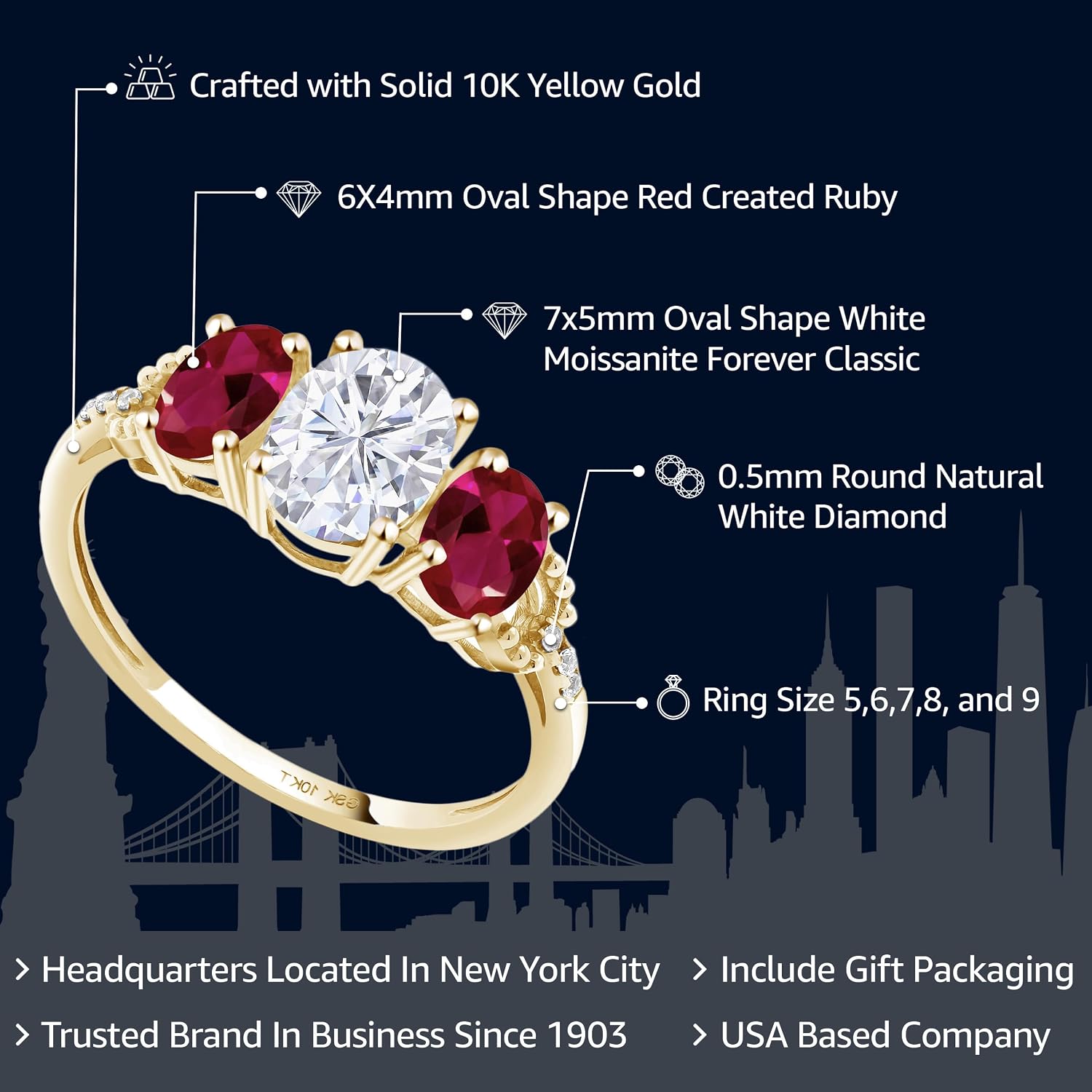
Imagine you’ve found the center stone — a round brilliant moissanite or a classic diamond solitaire — and now you’re staring at the band options. The default path is a pavé (tiny diamonds set closely together, like a glittering road) or a plain polished band. But then you see it: a setting where deep red rubies flank the center stone, or violet amethysts trace the shoulders of a white gold shank. Suddenly the ring looks like her — not just a ring. That’s the pull of colored gemstone accents, and it’s stronger in 2026 than it’s been in decades. This guide breaks down exactly when that choice makes financial and aesthetic sense, what tradeoffs you’re signing up for, and how to make the call with confidence — whether your total budget is $800 or $8,000.
Why Colored Accents Are Having a Moment (and Why the Math Often Works in Your Favor)
The Knot’s 2025 Jewelry & Engagement Study found that roughly 1 in 5 engagement ring purchases now incorporates a colored accent stone — up from closer to 1 in 8 five years prior. The driver isn’t just aesthetics. It’s economics layered on top of personalization.
Here’s the core tradeoff in plain terms: small diamonds are expensive relative to their visual contribution. A 1.5mm diamond accent — the size typically used in pavé side-stone work — costs meaningfully more per carat than a similarly sized ruby, sapphire, or amethyst, because diamond grading standards apply even to stones that are too small to grade properly by eye. You’re paying the diamond premium for a stone no one can distinguish from a colored alternative at arm’s length.
By the numbers:
- Average retail cost of a pavé-set all-diamond band upgrade (0.30 ctw): $400–$900 depending on metal and retailer
- Comparable ruby or sapphire accent band (0.30 ctw colored stones): $150–$450
- Moissanite accent band upgrade at retailers like Charles & Colvard: often $100–$300 below equivalent diamond weight
- Per GIA’s colored stone documentation, untreated Burmese rubies above 1 carat command a significant premium, but accent-grade rubies (under 0.10 ct each) are priced accessibly precisely because provenance documentation isn’t required at that scale
The savings on accent stones can be redirected toward a better center stone — a higher color grade, a larger carat weight, or a superior cut quality. That’s the practitioner’s lens: accents are a capital allocation decision, not just a style preference.
Stone-by-Stone: The Tradeoffs You Need to Name Before You Buy
Not all colored stones behave the same in everyday wear. This matters more for an engagement ring than almost any other jewelry category, because the piece will be worn daily, often for decades. The International Gem Society’s gemstone hardness and wearability guide uses the Mohs scale (a 1–10 rating of scratch resistance) as a baseline, but notes that hardness alone doesn’t tell the full wearability story — cleavage (how a stone breaks) and toughness (resistance to chipping) matter just as much.
Ruby and Sapphire (Corundum Family) — The Workhorse Choice
Both ruby and sapphire are corundum — the same mineral, different colors. They score 9 on the Mohs scale, second only to diamond (10) and moissanite (9.25). This makes them genuinely durable accent stones for daily-wear rings.
Tradeoffs to name explicitly:
- Heat treatment: The vast majority of commercial rubies and sapphires are heat-treated to enhance color. This is industry-standard and accepted, but if provenance matters to your buyer, untreated stones at accent size are rare and priced accordingly. For most buyers, treated stones are the right call.
- Color consistency in small sizes: Accent rubies can vary noticeably in hue from stone to stone at small calibrated sizes. Ask to see the ring in person or request macro photography before purchasing online. Reputable retailers like Brilliant Earth and James Allen show high-resolution imagery that makes this assessable.
- Red vs. the field: Ruby accents against a white diamond or moissanite center create maximum contrast — dramatic and personal. Sapphire (blue) against a warm-toned center reads more classical, closer to the Princess Diana / Kate Middleton aesthetic that Brides.com’s 2025 trend report identified as consistently driving search volume.
If-then rule: If your buyer wants maximum daily wearability AND a colored stone, ruby or sapphire is the answer. The hardness is there; the tradition is there; the price-per-visual-impact ratio is strong.
Amethyst — The Budget-Conscious Romantic Choice
Amethyst is a purple quartz, scoring 7 on the Mohs scale. That’s lower than ruby or sapphire, but still above the “acceptable daily wear” threshold most gemologists cite (roughly 6.5 and above for rings). The bigger wearability concern with amethyst isn’t scratching — it’s color fading under prolonged UV exposure. Deep violet amethyst can shift toward a cooler, paler lavender over years of sun exposure.
Tradeoffs:
- Price: Amethyst is genuinely inexpensive even at high quality. Accent-grade amethyst stones can cost a fraction of sapphire per carat, making them an excellent option for buyers stretching budget toward a premium center stone.
- Color stability: The fading risk is real but manageable. Rings worn mostly indoors, or on the non-dominant hand in lower-UV climates, fare better. This is a conversation worth having honestly with your buyer.
- Aesthetic: Violet-to-purple accents pair beautifully with rose gold (the warm metal amplifies the purple) and white gold (high contrast). Against a colorless moissanite or diamond center, the combination reads modern and distinctive.
If-then rule: If budget is the binding constraint and the buyer is aesthetically drawn to purple, amethyst accents on a rose gold band deliver exceptional visual impact per dollar. Just disclose the UV sensitivity upfront.
Moissanite Accents — The Technical Wildcard
Moissanite (silicon carbide) is increasingly used not just as a center stone but as accent stones. At 9.25 on the Mohs scale, it’s harder than ruby or sapphire. Its refractive index — the measure of how strongly it bends and disperses light — is higher than diamond, which means moissanite accents produce more colored “fire” (rainbow flashes) than diamond accents of the same size.
Pricescope’s community analysis of moissanite in accent positions notes that this high fire can actually compete visually with the center stone in certain lighting, which is either a feature or a bug depending on the design intent.
Tradeoffs:
- Consistency with the center stone: If the center is also moissanite, accent moissanite is the natural pairing. If the center is a natural diamond, moissanite accents may read as slightly “warmer” or more fiery in comparison — perceptible to trained eyes under direct light.
- Price: Moissanite accents are less expensive than diamond accents but typically more expensive than colored stone accents. They occupy the middle position on the cost curve.
- The “matching” conversation: Some buyers want everything to match precisely. Others love the subtle variation. Be explicit about which camp you’re designing for.
If-then rule: If the center stone is moissanite and the buyer wants a “diamonds everywhere” look without the diamond price, moissanite accents are the cleanest choice. If the center is natural diamond and budget is flexible, all-diamond accents preserve consistency.
The Settings That Maximize Colored Accents (and the One to Avoid)
Setting style interacts heavily with how accent stones read in a finished ring.
Channel setting (stones set flush inside a grooved channel in the band) protects small colored stones well and gives a sleek, modern look. Good for rubies and sapphires; adequate for amethyst.
Pavé and micropavé (stones set in tiny prongs or beads, sitting close to the surface) maximizes sparkle but leaves stones slightly more exposed to impact. Fine for hard stones (ruby, sapphire, moissanite); marginally riskier for amethyst over decades of wear.
Bezel setting (a rim of metal wraps around each stone) is the most protective option for softer stones and an excellent choice if durability is the top priority. The tradeoff is that less of the stone is visible, which can mute color impact.
The setting to approach carefully: Prong-set accent stones in a tension or open-rail band design look striking but require precision sizing and maintenance. Small colored stones in prong settings can loosen over time with daily wear. If choosing this style, budget for periodic prong inspection — most fine jewelers offer this service at low or no cost on rings purchased from them.
Making the Final Call: A Decision Framework
Here’s the explicit if-then map for the practitioner making this decision now:
| Situation | Recommendation |
|---|---|
| Budget is tight; center stone quality is the priority | Amethyst or sapphire accents → redirect savings to center stone |
| Daily wearability is non-negotiable | Ruby or sapphire (hardness 9); avoid amethyst if outdoor lifestyle |
| Center stone is moissanite; want visual cohesion | Moissanite accents for consistency; sapphire for contrast pop |
| Buyer has a signature color (birthstone, favorite hue) | Lean into it — colored accents are the natural vehicle for personalization |
| Buyer wants “bridal traditional” but with a twist | Blue sapphire accents with a diamond or moissanite center: historically grounded, distinctly personal |
| Center stone is a natural GIA-graded diamond, top color/clarity | All-diamond accents maintain value narrative; colored accents are still valid aesthetically but shift the ring’s character |
The broader principle, per GIA’s colored stone guidance, is that accent stones don’t need to meet the same documentation threshold as center stones — they’re chosen for visual effect and wearability, not investment value. That’s actually liberating: you can optimize for color, durability, and budget without needing GIA or AGS certificates on stones that are 1–2mm across.
The colored accent engagement ring isn’t a compromise. Executed well, it’s a ring that tells a story no all-diamond band can tell — and in 2026’s market, it’s often the sharper financial choice too.